RAMALLAH, (PIC)
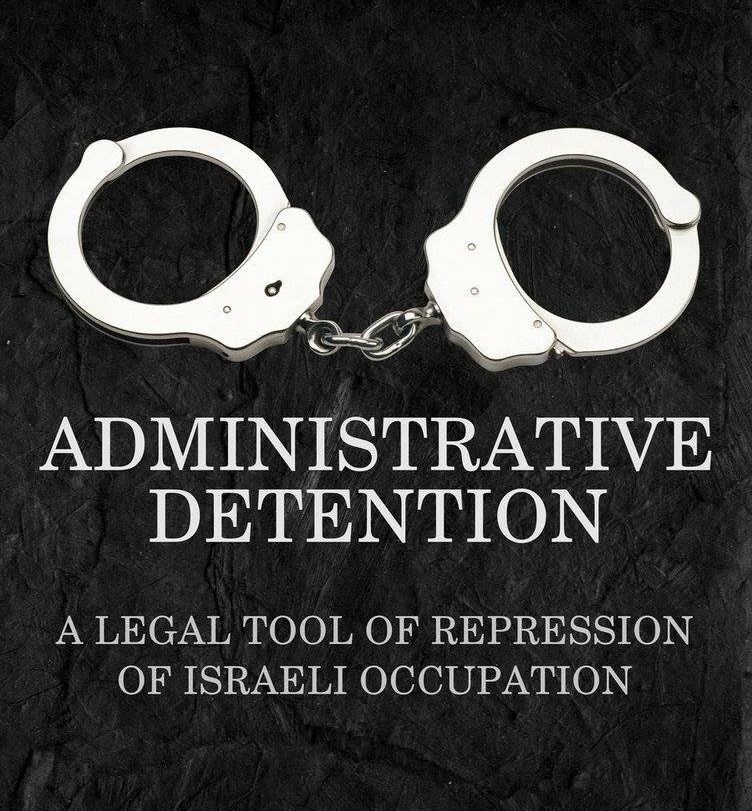
When the Israeli occupation forces arrest a Palestinian from his home at night, then tell his family and lawyer that the file is secret and that he will remain in prison for months that can be renewed without an indictment, the question becomes more than legal. What is administrative detention? For thousands of Palestinians, it is an organized Israeli policy of oppression used to strip a human being of freedom without a fair trial, and it turns security suspicion into an open-ended punishment.
Administrative detention, in the form known by Palestinians under occupation, is the detention of a person by a military or administrative order without directing a clear criminal charge, and without presenting public evidence that enables him to truly defend himself. The order may be specified for several months, but the most dangerous part is that this duration can be renewed time after time, so that the theoretically temporary detention turns into a practically indefinite imprisonment. Here lies the core of the matter: not only the absence of the charge, but the absence of a horizon as well.
What is administrative detention in the Palestinian context?
In abstract legal discourse, administrative detention may be presented as an exceptional measure that authorities resort to when there is an imminent danger that cannot be dealt with through the ordinary criminal track. But in the Palestinian case, the matter is no longer a rare exception. It has turned into an established tool within the occupation system to manage Palestinian society through deterrence, pressure, and depletion.
The occupation authorities issue administrative detention orders based on what they describe as secret files. The detainee himself does not view the details of these materials, and his lawyer usually does not obtain enough to discuss or refute them. Thus, the court session, in many cases, becomes a formal procedure more than being an actual space for defense. How can an individual respond to a claim he does not see? And how can a trial be fair if its basis is hidden from the owner of the case?
This is what makes administrative detention in the Palestinian experience directly linked to depriving prisoners of the most basic guarantees of justice. It is not based on a proven conviction, but on a unilateral security estimation owned by the occupation alone.
How does administrative detention actually work?
Often, the matter begins with a raid and arrest by the occupation forces, then transferring the prisoner to interrogation or detention, and after that, an administrative detention order is issued for a specified period, such as three months or six. When the end of the period approaches, this does not necessarily mean release. A new renewal can simply be issued based on the same secret file or on additional allegations that are not disclosed to the detainee.
This circle is what makes administrative detention one of the most psychologically cruel forms of detention. The prisoner does not know when his ordeal actually ends, and the family cannot build any certainty about the date of return. Time here becomes part of the punishment. Not the time governed by a final judicial ruling, but a suspended time, dependent on a decision that can be extended at any moment.
In many cases, this measure is used against university students, activists, community leaders, freed prisoners, and people against whom there are no public criminal charges in the first place. Therefore, Palestinians see it as a tool for political and social control, not just a limited security measure.
Why is it considered a dangerous issue on the legal and humanitarian dimensions?
The problem is not in the naming only, but in the structure upon which this type of detention is based. Any system that claims to respect justice is supposed to inform the accused of the charge, grant him the right to view the evidence, the right to discuss it, and the right to actual defense before an independent judiciary. Administrative detention bypasses almost all of these principles.
From the humanitarian angle, the harm does not fall on the prisoner alone. The entire family enters into a harsh state of waiting. The mother does not know when her son returns, the wife cannot organize her life on a clear basis, and the children experience the absence as if it is open without an end. This type of detention strikes psychological and social stability, and produces a collective punishment that goes beyond the prison walls.
How do the occupation authorities use it against Palestinians?
In the Palestinian experience, administrative detention cannot be separated from the reality of the occupation itself. It is part of a broader system that includes military courts, night raids, restrictions on movement, and political persecution. Therefore, Palestinians do not see it as a technical legal issue, but rather one of the tools to subjugate society.
The occupation authorities use it in moments of escalation, after popular campaigns, during periods of tension in Jerusalem and the West Bank, and sometimes to dismantle active student or community environments. It is also resorted to when there is not enough evidence to present a criminal file that can be tested publicly before the court. Here, the secret file turns into a ready exit that allows detention without the usual burden of proof.
This is precisely what raises widespread anger in the Palestinian street and among prisoners’ and human rights institutions. The issue does not relate to an individual or an isolated case, but to a repeated pattern that affects broad categories, and is used with a flexibility that makes its legal boundaries dangerously hazy.
Among 9,400 detainees currently in occupation prisons, there are 3,376 administrative detainees according to the Palestinian Prisoner Society (PPS).
What is the difference between administrative detention and a regular trial?
In a regular trial, there is a specific accusation, alleged facts, and evidence, even if fabricated and forged, that is presented and discussed, and an opportunity for defense and appeal. Many criticisms may remain for any judicial system, but the minimum level of procedures remains present theoretically and practically to varying degrees.
As for administrative detention, the detainee may not know in the first place what the act attributed to him is. He may be told that there is secret information stating that he poses a danger. This loose phrasing is enough to deprive him of freedom, without him owning an equal opportunity to refute it. Therefore, the difference here is not a simple procedural one, but a difference between a track that claims to test evidence, and a track that detains the person before any real test.
For this reason, many describe administrative detention as detention on the basis of expectation, suspicion, or security estimation, not on the basis of a crime proven before fair procedures.
Why do prisoners engage in strikes against administrative detention?
When the doors of justice are closed, prisoners resort to their bodies as the last space for confrontation. The hunger strike did not come from a vacuum, but from a deep feeling that the legal track within the occupation system does not grant the administrative detainee actual protection. Many prisoners have engaged in individual or collective strikes to break this form of detention, or at least to impose a clear release date.
The strike here is not just a protest against prison conditions, but an objection to the origin of the detention itself. The message sent by the striking prisoner is clear: the deprivation of freedom cannot be accepted for an unknown period on the basis of materials we do not know and cannot respond to.
Some of these strikes have succeeded in extracting decisions of non-renewal or setting a ceiling for detention, but they remain arduous battles that are costly health-wise and psychologically. This reveals the size of the defect in the entire system. When the body becomes the last method of litigation, that means the doors of natural justice are almost disabled.
Is there a legal justification or is the matter political?
The occupation presents security justifications, and this is expected from any party that wants to expand its powers. But the real question is not whether there is a legal phrasing that justifies the measure, but how this phrasing is used, upon whom it is applied, and within what boundaries. The law, when it is separated from justice and harnessed to serve an occupation power, turns into a cover for coercion instead of being a barrier against it.
In the Palestinian case, it is difficult to look at administrative detention in isolation from the political dimension. The selection of targeted people, the timing of arrests, and the nature of the environment located under occupation, are all indicators that the matter goes beyond the narrow security claim. We are in front of a tool used by a colonial authority to control the population located under its control, weaken their movement, and keep society in a state of permanent threat.
This does not mean ignoring the legal discussion, but rather putting it in its correct place. The problem is not only in the texts of the procedure, but in the balance of power that governs its application. When the party that arrests is the same party that hides evidence, manages military courts, and decides renewal, talking about sufficient guarantees becomes extremely fragile.
Why must this term be understood accurately?
Because language creates awareness. When administrative detention is presented as a cold legal term, its political and humanitarian essence may be lost. But understanding it accurately returns matters to their origin: a human being stripped of his freedom without a clear charge, without a fair trial, and without certainty of the end of detention.
For the Palestinian and Arab public, repeating the term is not enough. What is required is exposing what it hides of a daily reality that affects the prisoners and their families, and exposing the method in which legal language is used to beautify oppression. This is part of the battle of the narrative itself, which followers of the Palestinian cause know well, just as specialized platforms like PIC follow it in covering the prisoners’ file.
Understanding administrative detention is not a theoretical exercise. It is a necessary step so that prisoners are not reduced to figures, and so that it remains clear that freedom is not stripped only by long sentences, but also by decisions that are renewable indefinitely. The deeper this understanding is, the more solid and clear the defense of the prisoners becomes.

