GAZA, (PIC)
A woman giving birth by the light of a mobile phone. A mother searching desperately for clean water for her child. A family rationing the last handfuls of flour to survive barren days ahead.
This is only a fragment of what the phrase the suffering of Gaza’s women now contains. It is no longer merely a humanitarian description; it has become a condensed title for a policy of targeting that strikes the body, the home, the family, and collective memory all at once.
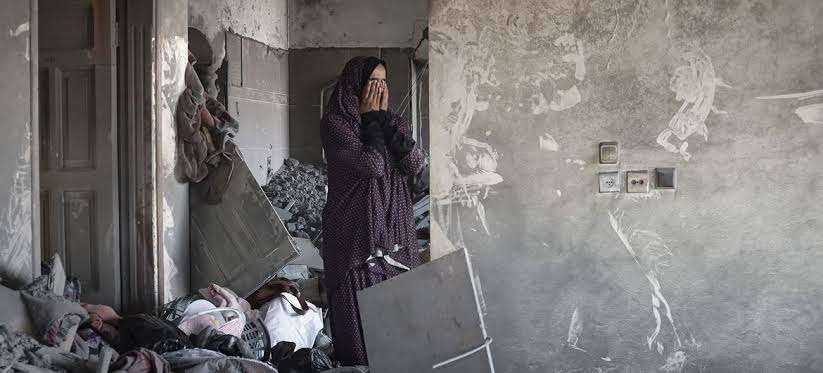
In Gaza, Palestinian women stand as living witnesses to what many observers and rights advocates describe as a genocide carried out by Israel. They have endured the loss of children, husbands, and relatives, the collapse of privacy, the disappearance of protection, and the constant accumulation of fear for those who remain alive. Women are not a marginal presence in this war. They are at its center, absorbing the consequences of bombardment, displacement, waiting, and the exhausting attempt to rebuild lives being dismantled piece by piece.
Gaza women: Not a side story
When discussion of the assault is reduced to military maps or statistics of destruction, a fundamental truth disappears: women in Gaza are facing a layered war.
There is the immediate threat of airstrikes. There is the expanding burden of care as basic services collapse. And there are deep psychological and social wounds that do not end when the guns fall silent.
To treat women’s suffering as a secondary humanitarian issue repeats the injustice itself, separating the crime from its daily consequences inside homes, shelters, and overwhelmed hospitals.
In Gaza, women pay the price of Israeli military power most intensely when they become the axis around which survival revolves. They must protect children, secure minimal food supplies, care for the sick and elderly, console the grieving, and manage the mechanics of daily survival in conditions unfit for human life, all while they themselves remain exposed to death, injury, or devastating loss.
A war on home and body
In Gaza, a home is not merely walls and furniture. It is safety, dignity, and social protection. When houses are bombed or families are forced to flee, women lose more than shelter; they lose the space through which they organize and control their lives.
Displacement thrusts them from familiar environments into chaotic, overcrowded realities where water, sanitation facilities, and privacy are scarce or non-existent.
Inside shelters, new layers of suffering emerge. Women and girls struggle to secure basic necessities related to personal hygiene and reproductive health, needs that are fundamental rights, not luxuries. Under siege and bombardment, however, these rights become nearly unattainable. Their absence directly affects both physical health and psychological well-being, eroding dignity itself.
Pregnancy and childbirth offer perhaps the harshest example. A pregnant woman in Gaza fears not only labor pain but whether she will reach a hospital at all, whether a bed exists, whether electricity will remain on, whether medical staff or medication will be available. Some women are forced to give birth in unsafe conditions, often without anesthesia or adequate medical supervision, during moments that should represent life’s greatest protection. Here, the reality of the crime becomes unmistakable: the targeting of life’s very conditions.
Motherhood under fire
Mothers in Gaza are expected to remain strong at all times, yet this widely repeated image conceals another injustice. Strength here is not a choice; it is an obligation imposed by war.
Mothers hide their fear so their children do not collapse emotionally. They promise a future they themselves cannot guarantee. They confront hunger, displacement, or the loss of fathers and brothers while being expected to absorb everything at once.
Many women endure a double loss: the death of loved ones followed by the loss of the ability to grieve normally. There is no time for mourning while searching for survivors, arranging evacuation, or standing in endless lines for bread and water. Trauma becomes deferred, accumulating silently and leaving wounds that may last for years.
The siege multiplies the suffering
The war did not begin on empty ground. It unfolded atop years of blockade that weakened Gaza’s healthcare system, reduced employment opportunities, deepened poverty, and expanded dependence on aid.
When large-scale military assault occurs, this structural fragility collapses completely. Women pay a disproportionate price because they are often responsible for managing scarcity within households.
When food runs short, women are usually the first to reduce their own portions. When medicine disappears, many postpone their own treatment to preserve what remains for children or elderly relatives. As economic pressure intensifies, anxiety and social strain expand inside already fragile homes.
These are not romantic acts of sacrifice. They are indicators of a profound imbalance in the conditions of survival imposed by occupation and siege.
Thousands of women who have lost husbands or primary breadwinners suddenly carry full responsibility for families in a devastated environment. Their resilience may appear extraordinary, but adaptation to catastrophe should never be mistaken for acceptance of it. Palestinian endurance does not erase the right to protection or justice.
Between displacement and daily humiliation
Displacement in Gaza rarely means moving to safety. It often means moving from one danger to another from overcrowding to deeper overcrowding, from instability to complete uncertainty.
Women confront countless daily questions rarely reflected in headlines: Where will the family sleep? How can clothes be changed? How can adolescent girls retain privacy? How can children be protected simultaneously from illness and fear?
These details are not minor. Daily humiliation becomes part of the structure of targeting itself. When a woman loses the ability to manage the most basic aspects of life and must beg for water, bread, or medical care, her dignity is directly assaulted.
Reducing this reality to neutral humanitarian language risks obscuring the political nature of what is unfolding: not merely a crisis of needs, but the outcome of a systematic coercive policy.
The psychological toll beyond numbers
Statistics count the dead, the wounded, and the displaced but they cannot fully measure what settles inside the human psyche.
Women across Gaza live with chronic anxiety, insomnia, panic attacks, and an enduring sense of insecurity. A child watching her mother unable to protect her internalizes fear as a permanent memory. A mother who cannot calm her children under bombardment carries an invisible wound that outlives the moment itself.
Yet women in Gaza cannot be reduced to victims alone. They remain witnesses, actors, and guardians of social continuity. They reorganize life amid rubble, invent ways to endure, and prevent the total collapse of families and communities.
Acknowledging this strength must never become an excuse to normalize their suffering or demand further endurance from them.
Why this must be understood politically
Any discussion of Gaza’s women is incomplete if detached from its political context. What is happening is not a natural disaster nor merely a failure of local administration. It unfolds within the framework of Israeli occupation, military assault, and prolonged siege.
Humanitarian sympathy alone softens reality rather than revealing it. Women in Gaza require urgent aid but before that, they require an end to targeting, the lifting of the blockade, and accountability for crimes committed against civilians.
A purely charitable lens portrays women as passive recipients of relief. A justice-based approach recognizes them as human beings with full political, national, and human rights. Defending Gaza’s women therefore means more than delivering emergency assistance; it means rejecting narratives that justify Palestinian deaths, equate victim and perpetrator, or treat Palestinian suffering as fleeting news.
Media responsibility is central here. Ethical storytelling must not stop at images of grief beneath rubble; it must explain why such scenes exist, who caused them, and how this catastrophe continues to unfold before the world’s eyes.
What do Gaza women need now?
The answer is multilayered.
There is an urgent need for food, clean water, medicine, and healthcare, including maternal services, safe childbirth facilities, and psychological support. There is a need for shelters that preserve minimal privacy and safety.
Above all, however, there is a need for genuine international political will capable of halting the machinery of destruction itself. Humanitarian responses will remain limited as long as the root causes persist.
Equally vital is space for Gaza’s women to tell their own stories. Testimony is not a media detail; it is part of a struggle over narrative and rights. When a woman describes her day under bombardment her loss, her enforced patience she exposes a structure of oppression the world is being asked to normalize.
The discussion must move beyond sympathy toward a clear moral and political stance. Every woman protecting her children amid ruins delivers a direct message to the world: do not ask the victim to adapt further, stop the conditions that have turned life itself into a daily battle for survival.
The cost of war on women and girls
UN Women has revealed, in a report, devastating figures documenting the scale of loss: more than 38,000 women and girls killed in the Gaza Strip between October 2023 and the end of 2025, an average of nearly 47 victims every day. The data underscores the widening civilian toll, particularly among women and children, and reflects the deepening humanitarian catastrophe and its structural consequences for Palestinian society.
According to the report “The Cost of War in Gaza on Women and Girls,” the victims included more than 22,000 women and 16,000 girls, alongside approximately 11,000 injured, many left with permanent disabilities, factors that severely undermine prospects for long-term social recovery amid continuing human loss.
In official remarks, regional director of UN Women Moaz Dajani described the war’s impact as “devastating,” noting that it has not only produced enormous casualty numbers but fundamentally reshaped family structures. Tens of thousands of households are now headed by women forced into sole responsibility under escalating economic hardship and persistent security threats, evidence of profound and coercive transformations within Gaza’s social fabric.

